Essential Principles for Mindful Living
- ✦ Prana Pratishtha Consecration: Every crystal specimen is cleansed in living Ganges waters and calibrated to 432 Hz frequency in Varanasi before dispatch.
- ✦ Grounding Physics: Authentic fullerenes and natural crystalline lattices attenuate high-frequency EMF static, anchoring the Root Chakra (Muladhara).
- ✦ Tactile Ritual Integration: Wearing consecrated beads on the non-dominant receptive wrist or placing tetrahedral pyramids on your workspace establishes an impenetrable aura shield.
While quartz is often celebrated for its aesthetic beauty in the wellness community, its true power lies in its rigorous physical properties. Beyond the visual appeal of a clear crystal point is a sophisticated transducer—a material capable of converting mechanical energy into electrical signals. This phenomenon, known as piezoelectricity, is the foundation of modern chronometry, telecommunications, and digital processing.
Understanding the science of quartz allows us to move beyond anecdotal claims and into the realm of solid-state physics. By examining how the crystalline lattice reacts to pressure, we can better appreciate why this mineral has become the heartbeat of our technological age.
Quick Reference: Quartz Mineralogical & Electrical Profile
| Feature | Technical Specification | Practical Application |
|---|---|---|
| Chemical Formula | SiO₂ (Silicon Dioxide) | High chemical stability for long-term use. |
| Crystal System | Trigonal (Hexagonal) | Non-centrosymmetric structure allows for piezoelectricity. |
| Mohs Hardness | 7 | Durable enough for industrial and daily wear. |
| Piezoelectric Constant | 2.3 pC/N | High sensitivity to mechanical stress. |
| Thermal Stability | High (up to 573°C) | Reliable performance in electronic circuits. |
The Deep Dive: The Molecular Mechanics of Quartz
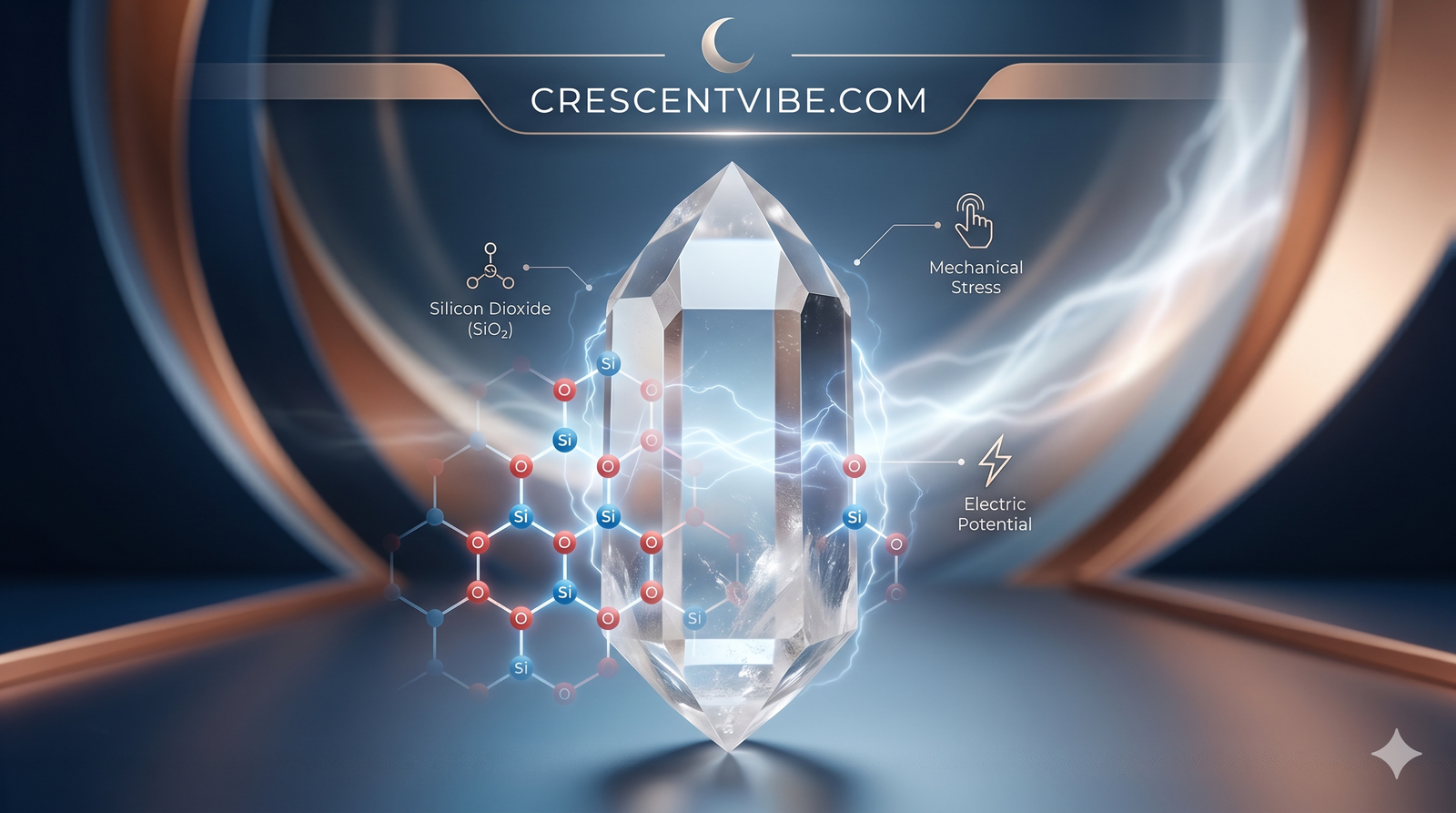
To understand how quartz works, we must look at its atomic architecture. Quartz is composed of Silicon-Oxygen tetrahedra. In its natural state, these atoms are arranged in a highly ordered, repeating 3D lattice.
The Non-Centrosymmetric Secret
Most materials have a "center of symmetry," meaning their electrical charges are balanced even when deformed. Quartz is different. It is non-centrosymmetric. Under normal conditions, the positive and negative charges within the crystal lattice cancel each other out, leaving the crystal electrically neutral.
However, when you apply mechanical stress—such as squeezing, bending, or hitting the crystal—the atoms are displaced. Because of the unique trigonal symmetry of quartz, this displacement shifts the centers of the positive and negative charges. This shift creates a dipole moment, resulting in an electrical potential (voltage) across the crystal.
The Inverse Piezoelectric Effect
Equally important is the Inverse Piezoelectric Effect. When an electrical current is applied to a quartz crystal, the lattice physically deforms. If that current is oscillated at a specific frequency, the crystal begins to vibrate.
Because quartz is physically rigid and has a low internal damping rate, it vibrates at an extremely precise frequency. This is known as Resonance. This precise "heartbeat" is what allows a tiny sliver of quartz to keep time in a watch or synchronize data packets in a high-speed fiber-optic network.
Historical Context: From Curie to Computers
The piezoelectric effect was first discovered in 1880 by brothers Jacques and Pierre Curie. They found that applying pressure to crystals like tourmaline and quartz generated electricity.
By World War I, researchers used this "electric stone" to develop the first SONAR systems, using quartz transducers to detect underwater submarines. In the 1920s, the first quartz clock was developed, providing a level of precision that mechanical gears could never achieve. Today, you are likely within five feet of several quartz oscillators—they are in your smartphone, your microwave, and your car’s engine control unit.
Modern Application: Integrating Quartz into a 2026 Lifestyle
In 2026, the boundary between "tech" and "wellness" is blurring. We no longer view minerals merely as desk ornaments; we see them as functional tools for environmental calibration.
1. The High-Performance Tech Desk
For professionals spending 8+ hours a day in front of high-frequency screens, quartz serves as a grounding physical anchor. While the "quartz" inside your computer is busy processing data, a raw Clear Quartz or Smoky Quartz cluster on the desk provides a tactile "reset" point.
- Application: Place a [Internal Link: Large Quartz Cluster] between yourself and your primary monitor to serve as a visual reminder of structural stability amidst digital chaos.
2. Bio-Feedback and Meditation
The piezoelectricity of quartz makes it highly responsive to temperature changes (pyroelectricity) and pressure. During meditation, holding a quartz palm stone allows the mineral to warm to your body temperature.
- Application: Use a quartz point during breathwork. As you apply rhythmic pressure to the stone, the subtle electrical shifts interact with the skin's mechanoreceptors, deepening the mind-body connection.
3. Structural Water Harmonization
While the "memory of water" is a topic of ongoing debate, the physical use of quartz in filtration systems is undeniable. Quartz sand is a primary component in high-grade water purification because of its chemical inertness and durability.
- Application: Use [Internal Link: Quartz Infusion Sets] to maintain water purity and clarity in your home office.
The "Cresent Vibe" Difference
At Cresent Vibe, we believe that the bridge between the ancient earth and modern technology shouldn't be built on "fluff." It should be built on integrity. Our curation process is governed by the Mineralogical Integrity Protocol (MIP).
Every specimen we source is vetted not just for its visual "vibe," but for its structural perfection. We prioritize Ethical Sourcing, ensuring that our crystals are extracted using methods that respect the local geology and the workers involved. We use Raman spectroscopy to verify the purity of our higher-end specimens, ensuring that when we say it's "Clear Quartz," it is free from synthetic polymers often found in mass-market stones.
We are tech-forward. We believe that by understanding the piezoelectric nature of your crystals, you can better integrate them into a smart-home environment where nature and silicon coexist.
Expert FAQ: Understanding Quartz Mechanics
Q: Can a quartz crystal actually run out of electricity?
A: No. Quartz does not "store" electricity like a battery; it converts energy. It will produce an electrical charge as long as mechanical stress is applied. In electronic devices, the battery provides the initial push, and the quartz regulates the rhythm.
Q: Is there a difference between natural and synthetic quartz?
A: Chemically, they are identical (SiO₂). However, synthetic quartz is grown in autoclaves for industrial precision (perfectly clear, specific sizes). Natural quartz contains inclusions and lattice distortions that many enthusiasts believe provide a more complex "energetic profile" or unique resonance.
Q: How do I "recharge" a piezoelectric stone?
A: From a physics standpoint, "cleansing" a stone is about returning the lattice to a state of equilibrium. Rinsing quartz in distilled water or exposing it to sunlight provides thermal and kinetic energy that can help stabilize the crystal's internal structure. [Internal Link: Guide to Crystal Maintenance].
Q: Does the size of the quartz affect its frequency?
A: Absolutely. In electronics, the thickness and cut of the quartz wafer determine its resonant frequency. This is why different shapes—like pyramids, spheres, or raw points—interact with light and physical pressure in distinct ways.
The Intersection of Mineralogy and Wellness
The story of quartz is the story of human progress. We have moved from using flint for fire to using quartz for the Global Positioning System (GPS). When we bring a piece of quartz into our homes, we aren't just bringing in a "pretty rock." We are bringing in a piece of the Earth's crust that possesses the literal ability to transform one form of energy into another.
By focusing on the Silicon Dioxide structure and the piezoelectric effect, we can strip away the pseudoscience and appreciate quartz for what it truly is: an incredible feat of natural engineering. Whether you are using it to stabilize your focus at a tech-heavy workstation or as a tool for grounding during a 2026 digital detox, quartz remains the most functional mineral in the modern world.
Also Read:
- Shop our Laboratory-Verified Quartz Collection
- The Physics of Amethyst - A Purple Variation