Essential Principles for Mindful Living
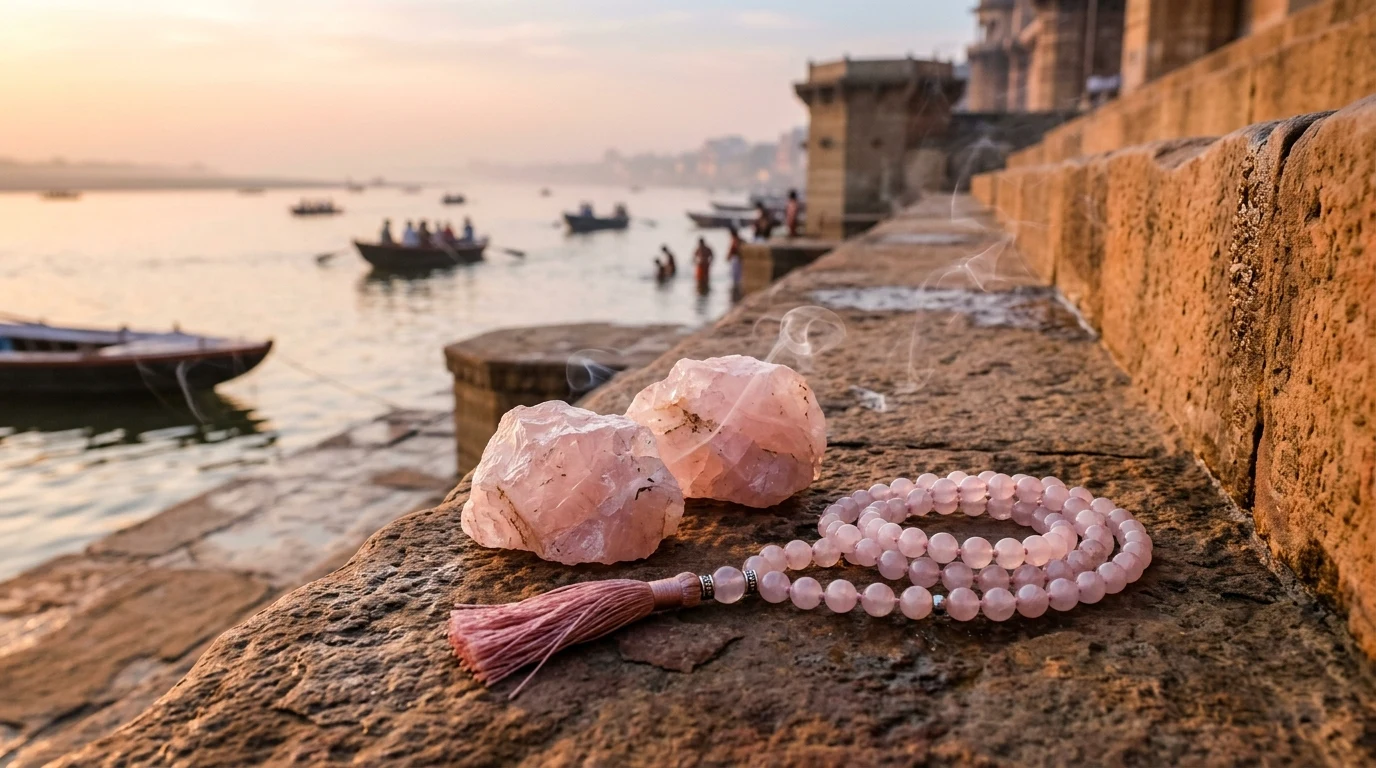
- ✦ Prana Pratishtha Consecration: Every crystal specimen is cleansed in living Ganges waters and calibrated to 432 Hz frequency in Varanasi before dispatch.
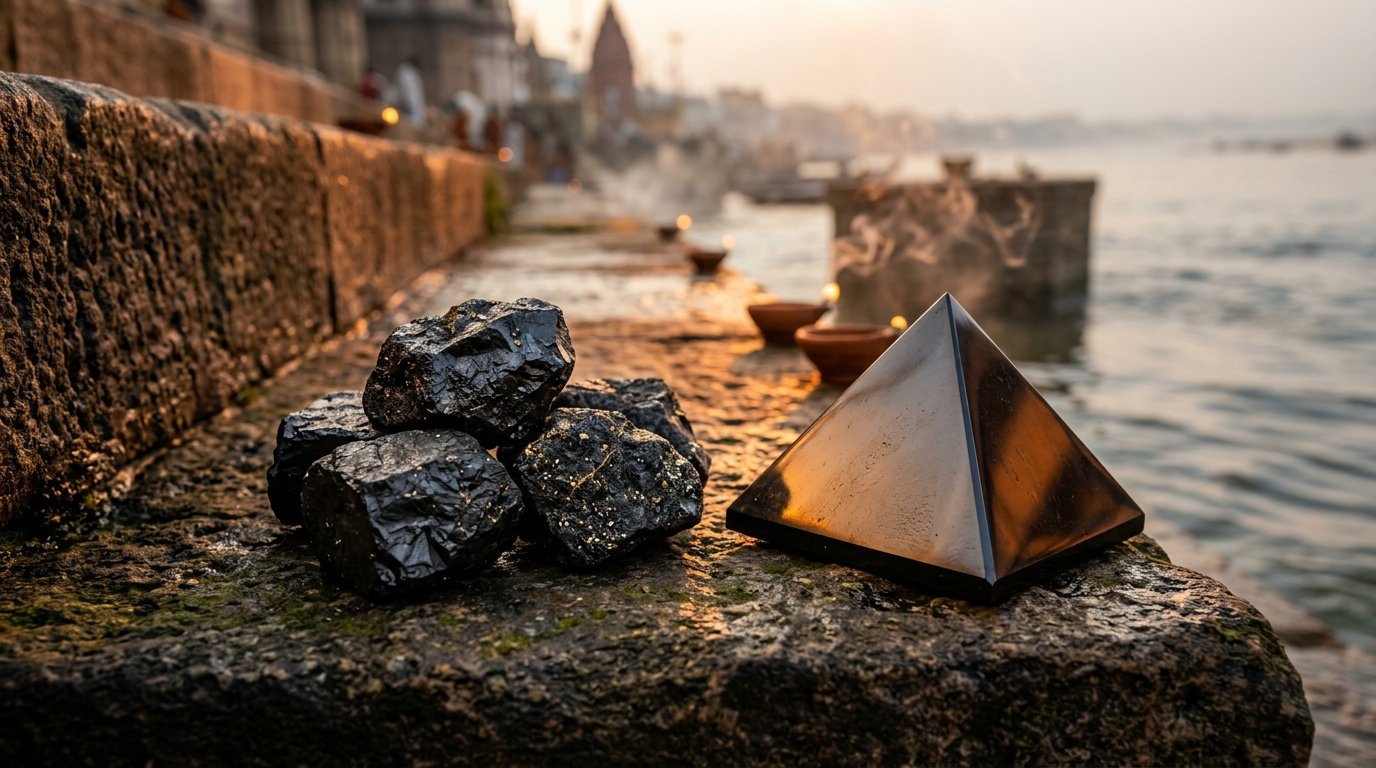
- ✦ Grounding Physics: Authentic fullerenes and natural crystalline lattices attenuate high-frequency EMF static, anchoring the Root Chakra (Muladhara).
- ✦ Tactile Ritual Integration: Wearing consecrated beads on the non-dominant receptive wrist or placing tetrahedral pyramids on your workspace establishes an impenetrable aura shield.
Article Insights
- Scientific Depth: High (Level 4/5)
- Key Discovery: Radiation-induced F-centers as the source of violet pigmentation.
- Primary Mineral: SiO2 (Trigonal Quartz)
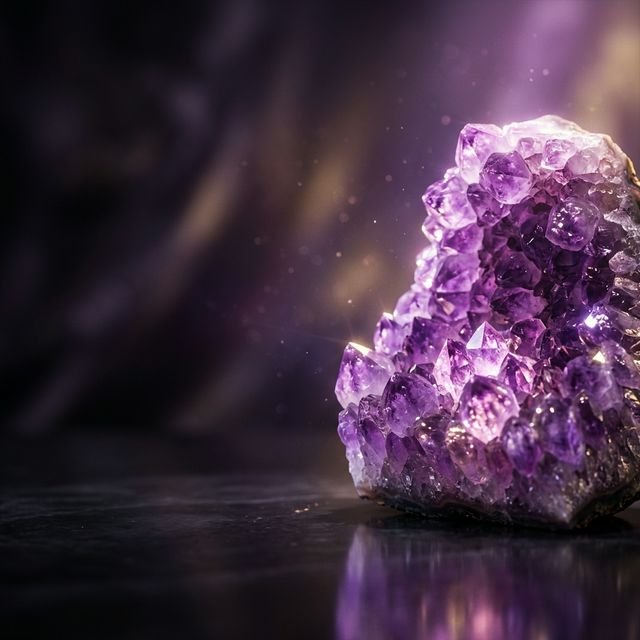
Amethyst is frequently relegated to the realm of aesthetics or basic spirituality, yet its true identity lies in a complex interplay of solid-state physics and trace element chemistry. As the most coveted variety of macrocrystalline quartz, Amethyst represents a specific geological "error"—a substitution of silicon by iron, followed by natural irradiation. Understanding the Physics of Amethyst requires looking beyond the violet hue to the lattice-level dynamics that define its frequency and durability.
Technical Specifications: At a Glance
Before delving into the quantum mechanics of color centers, let us establish the physical baseline for this silicon dioxide ($SiO_2$) variant.
| Property | Specification | Significance |
|---|---|---|
| Chemical Formula | $SiO_2 + Fe^{3+}$ | Iron impurities are essential for the purple color. |
| Crystal System | Trigonal (Hexagonal) | Determines the directional flow of energy/stress. |
| Mohs Hardness | 7.0 | High durability for daily interaction and tech-desk use. |
| Refractive Index | 1.544 – 1.553 | Influences how light scatters through the lattice. |
| Specific Gravity | 2.65 | Consistent density for identifying genuine specimens. |
| Cleavage | None (Conchoidal fracture) | Resilient against structural splitting. |
1. The Atomic Architecture of Amethyst
To understand Amethyst, one must first understand Quartz. In its pure state, Quartz is a clear, repeating lattice of silicon and oxygen. Amethyst emerges when interstitial iron ($Fe^{3+}$) replaces silicon within the crystalline structure during the growth process.
The Color Center (F-Centers)
The purple coloration is not merely a "dye" within the stone; it is an optical phenomenon caused by radiation-induced color centers. When iron-bearing quartz is exposed to natural gamma radiation from surrounding granitic rocks:
- An electron is displaced from the iron impurity.
- This creates an "electron hole" or a specific energy state.
- This state absorbs specific wavelengths of light (yellow-green), leaving only the violet-red spectrum to reach the human eye.
This process is reversible. If Amethyst is exposed to high temperatures (approx. 400°C to 500°C), the electrons return to their original states, and the stone typically transforms into yellow Citrine or green Prasiolite.
2. Piezoelectricity and the Silicon Frequency
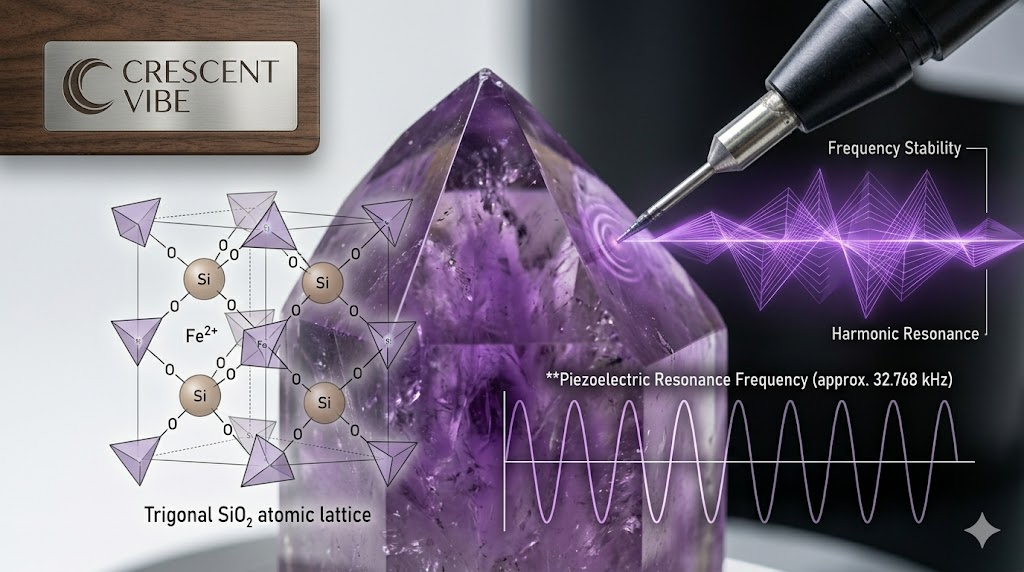
One of the most profound physical attributes of Amethyst is its piezoelectric property. In physics, piezoelectricity is the ability of certain materials to generate an electric charge in response to applied mechanical stress.
Because Amethyst is a variety of Quartz, it maintains a precise oscillation frequency. This is the same principle that allows Quartz to power high-precision clocks and radio transmitters. When placed in a modern environment—surrounded by the electromagnetic interference (EMI) of hardware and high-speed Wi-Fi—the stable lattice of Amethyst acts as a grounding anchor. It does not "block" signals, but rather provides a consistent physical reference point in a space filled with chaotic electronic noise.
[Internal Link: The Science of Quartz Oscillation]
3. Geological Origin and Formation Energetics
Amethyst primarily forms in geodes within volcanic rocks. These cavities are created by gas bubbles in cooling lava. As hydrothermal fluids rich in silica and iron circulate through these voids, they precipitate crystals over millions of years.
- Zonal Growth: Higher quality Amethyst often shows color zoning—triangular patches of deeper purple. This is a result of varying iron concentrations during different stages of the crystal's growth.
- Thermal Stability: Understanding the thermal limits of Amethyst is vital for its preservation. Long-term exposure to UV radiation (direct sunlight) can "bleach" the color centers, causing the stone to fade back toward clear quartz.
4. Modern Application: Integration in a 2026 Lifestyle
In 2026, the boundary between the digital and the physical has blurred. Amethyst is no longer just a decorative object; it is an ergonomic tool for the high-performance workspace.
The Tech-Desk Anchor
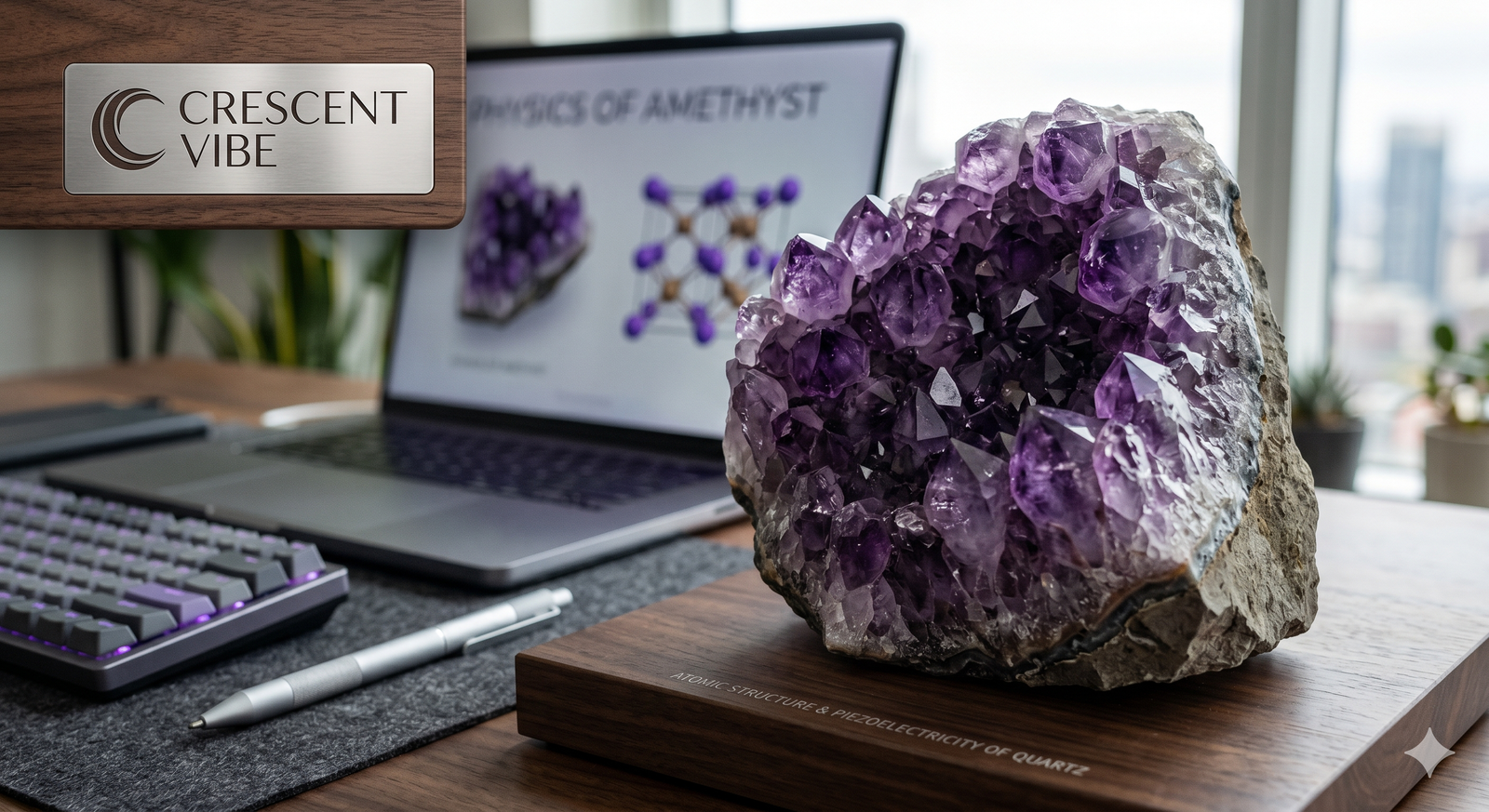
As we spend more time interacting with haptic interfaces and spatial computing, physical grounding becomes a biological necessity. Placing a high-mass Amethyst geode near a workstation serves a dual purpose:
- Tactile Reset: Touching a material with a Mohs hardness of 7 provides a distinct sensory contrast to plastic and glass.
- EMI Mitigation: While not a "shield," the stone’s stable dielectric constant helps in creating a localized area of atmospheric stability.
Bio-Harmonization and Sleep Science
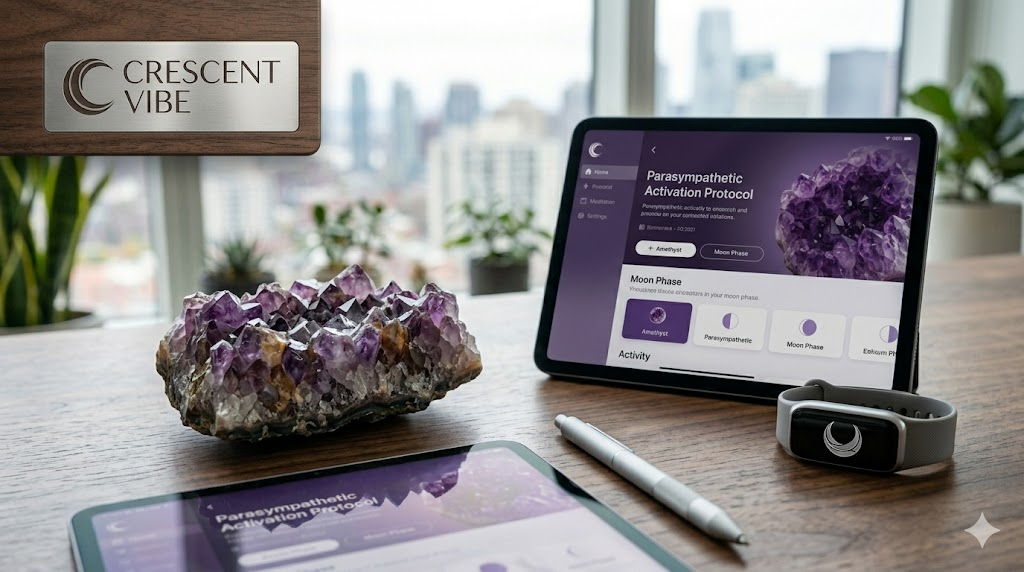
The physics of Amethyst also extends to thermal conductivity. Amethyst is naturally cool to the touch and has a high heat capacity. Many modern wellness protocols involve using Amethyst-weighted eye masks or mats to assist in parasympathetic nervous system activation. The gentle, consistent pressure combined with the stone's thermal properties helps lower the heart rate and prepare the body for deep-cycle sleep.
[Internal Link: Ergonomic Wellness Tools]
5. The "Cresent Vibe" Difference
At Cresent Vibe, we approach mineralogy through the lens of Technical Integrity. We recognize that the "vibe" of a stone is the sum of its physical properties—its density, its chemical purity, and its structural origin.
Our curation process involves spectroscopic analysis to ensure that every Amethyst specimen we offer has a genuine, radiation-induced color center, rather than being synthetically dyed or heat-treated. We source exclusively from ethical mines in Uruguay and Brazil, prioritizing clusters that maintain their natural termination points. By bridging the gap between raw geological power and the modern aesthetic, we provide tools that aren't just beautiful—they are physically resonant with the demands of a high-tech home.
6. Historical Context: From Royalty to Research
Historically, Amethyst was prized as a "Gem of Fire," sometimes worth as much as Diamond. The Greeks believed its molecular structure could prevent intoxication (hence the name amethystos, "not drunken"). While we now know that its chemical makeup doesn't filter alcohol from the bloodstream, the psychological anchoring provided by its deep violet hue has been documented for millennia.
In the 20th century, the discovery of the Bohr model and Quantum Mechanics allowed us to finally understand why it is purple. We transitioned from mythology to the study of ligand field theory, which explains the electronic transitions in the iron ions within the stone.
7. Maintenance and Longevity
To preserve the physical integrity of your Amethyst, follow these data-driven care steps:
- Avoid Ultrasonic Cleaners: High-frequency vibrations can occasionally trigger fractures in stones with hidden inclusions.
- Chemical Sensitivity: Avoid exposure to hydrofluoric acid or strong alkaline solutions, which can etch the surface of the silica.
- Cleansing: For those focusing on the "vibe," use sound-cleansing (via tuning forks at 4096 Hz) to clear the stone of accumulated physical dust and resonant interference.
Expert FAQ
Does Amethyst lose its color over time?
Yes, Amethyst is photosensitive. If placed in direct, intense sunlight for extended periods, the gamma-radiation-induced color centers can "reset," causing the purple to fade to a pale grey or yellow. It is best kept in ambient or low-light environments.
What is the difference between Amethyst and "Heat-Treated Citrine"?
Most commercial Citrine is actually Amethyst that has been baked in industrial ovens. Physics-wise, the heat collapses the "electron holes" responsible for the purple color and alters the oxidation state of the iron, turning it orange/yellow. True Citrine is rarer and colored by different mechanisms.
Can Amethyst survive a drop on a hard floor?
While Quartz has a Mohs hardness of 7, it is brittle. It possesses a conchoidal fracture pattern, meaning it will chip or shatter like glass if subjected to a sharp impact. Always handle large clusters with two hands.
How does Amethyst interact with Wi-Fi signals?
Amethyst is a dielectric material. While it does not "absorb" Wi-Fi in a way that would disrupt your internet connection, its presence can subtly influence the local electric field. It is largely used as a grounding tool for the user rather than a filter for the device.
Conclusion: The Synergy of Science and Serenity
The Physics of Amethyst reminds us that nature is the ultimate engineer. By replacing a few silicon atoms with iron and subjecting them to the earth's natural energy, we get a stone that is a masterclass in optical physics and structural stability. Whether you are looking to ground your digital workspace or simply appreciate the billion-year journey of a volcanic geode, Amethyst remains the gold standard for the modern mineral collector.
Also Read:
- Shop the Amethyst Collection
- The Mineralogy of the Home Office